Autonomous Debris-Collection Robot
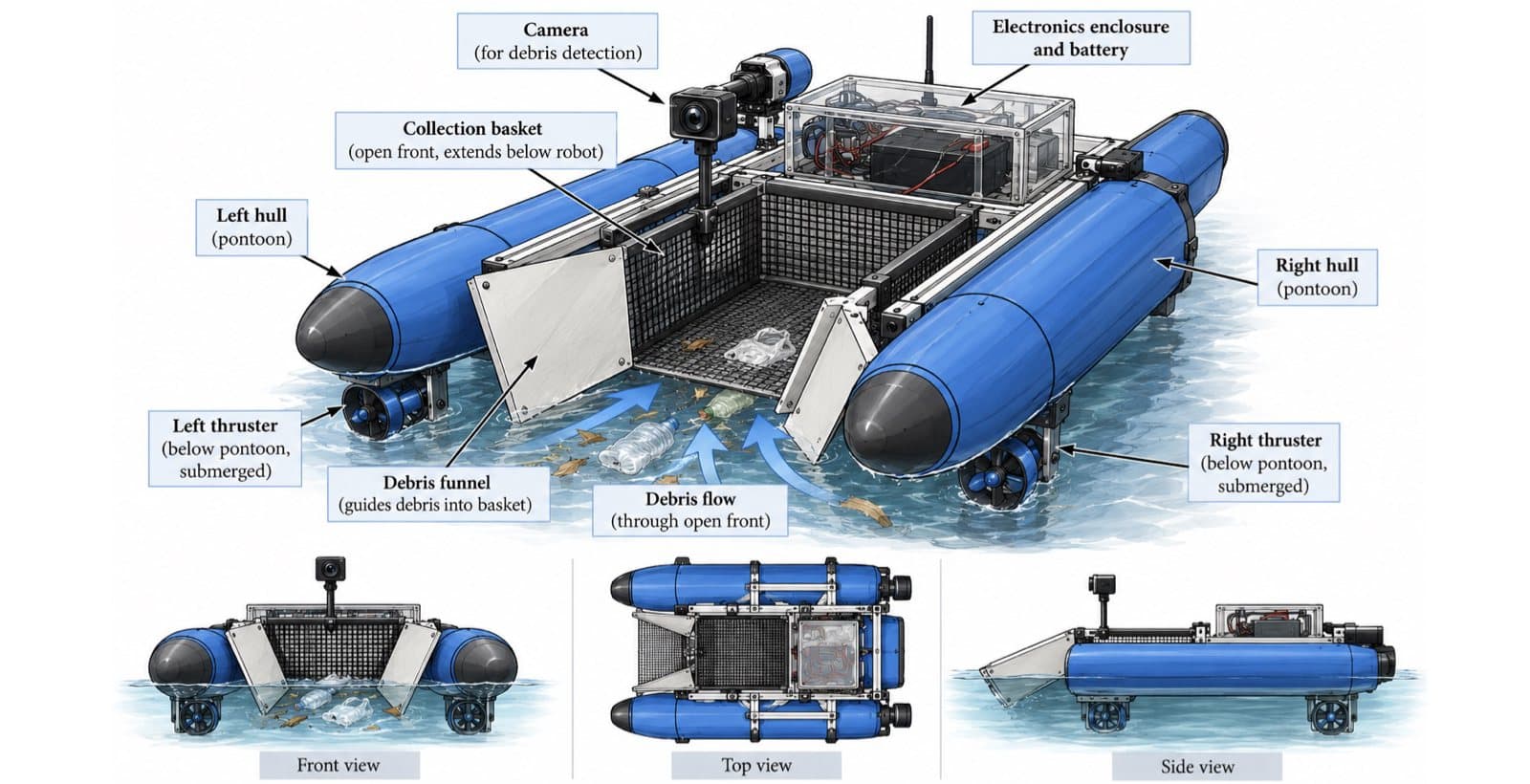
- Hamad Alkuwaiti
- Soud Alkharji
- Sami Hamdi
- Ibrahim Obaidan
- George Benyameen
Timeline: Sep 2026 – Present
Role: EC463: Senior Design
Stack Raspberry Pi 5, AI HAT+, ESP32, IMX708 camera, NEO-M8N GNSS, IMU, Wi-Fi + RC link, brushless thrusters
- Designing the Navigation & Autonomy subsystem I own on a 6-person team's river robot: a nine-state mission machine on a Raspberry Pi 5, and an ESP32 that runs the 100 Hz PD heading loop, thrust mixing and all stops
- Designed an ESP32 safety watchdog that zeroes thrust within 0.3 s of losing the host's 20 Hz heartbeat or after 1 s of operator-link silence, and triggers RETURN after 30 s of link loss
- Derived the approach design: a 0.3 m/s speed that reaches targets in about 17 s against the 30 s limit, and a ±4.4° heading hold over the 2 m camera blind leg from the 0.155 m funnel tolerance
- Designed latency compensation for the approach: the heading reference adds the camera bearing to the IMU heading at frame-capture time, so perception's processing delay does not become heading error
- Rejected GNSS for terminal guidance in a trade study (NEO-M8N 95% error of 4.2–5.2 m, about 30× the funnel tolerance) and used it for 5.0 m lawnmower coverage rows with 23% overlap and a 4.2 m geofence inset
- Co-developing the perception pipeline with a teammate: tiled 640×640 detection on the waterline band, run on a Raspberry Pi 5 with a 13 TOPS AI HAT+ and an IMX708 camera, targeting 17.1 FPS
Links and documents
No public links or documents for this one yet.